
An Interview with Tsering Woeser
Kamila Hladíková
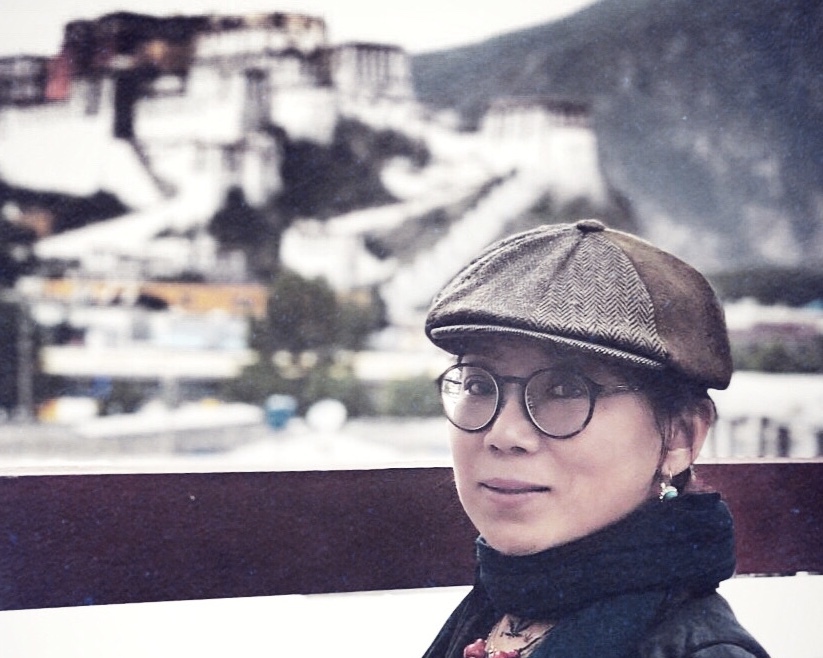
Born in Lhasa in the summer of 1966, amid the turbulence at the outset of the Cultural Revolution, Tsering Woeser’s mixed Sino-Tibetan origins and early education in Mandarin prefigured the poet’s estrangement from her ancestral land. Her lifelong exile was first spiritual, and then, inevitably, material. Unlike many of her fellow uprooted Tibetans, the present locus of her exile is Beijing, where she is largely confined to a heavily surveilled high-rise on the outskirts of the city’s inner circle. The view from her window stretches to the chaotic tangle of highways and flyovers of the outer ring roads, foregrounded by a forest of cranes and skyscrapers. Yet the apartment itself, furnished in the Tibetan style, featuring an agglomeration of Tibetan Buddhist objects and a small personal shrine, provides tranquil refuge from the curtain of smog shrouding the megalopolis that hems Woeser in.
For Woeser, the ultimate refuge, however, is her wide-ranging writing practice, comprising poetry, essays, blogging, and documentary narratives of modern Tibetan history. Though her mother tongue is Tibetan and she grew up speaking a Kham dialect, Woeser learned to read and write only in Chinese. During the economic boom of the nineties, she had the opportunity to publish her works on the Chinese market but ultimately chose not to comply with the strictures of the official system.
Her first poetry collection, Tibet Above, was published in 1999 by the Tibetan People’s Publishing House of Qinghai Province. Her second book, the essay collection Notes on Tibet, however, skirted more traditional publishing channels and was carried by an influential liberal publisher in Guangzhou controversial within the Party. It was banned as soon as the authorities in Lhasa caught wind of it. This proved to be a pivotal moment for Woeser, galvanizing her desire to write more openly about the situation in Tibet. The first thing she focused on after becoming a “dissident” was the heavily tabooed subject of the Cultural Revolution in Tibet. In 2006, she published Forbidden Memory: Tibet during the Cultural Revolution, a documentary treatment of personal photographic material left behind by her father (a high-ranking officer in the People’s Liberation Army), and Memory of Tibet, a collection of oral histories. A prolific blogger and essayist, Woeser remains a poet at heart. Rebel Under the Burning Sun, a new collection written during the author’s last visit to Lhasa in spring and summer 2018, is forthcoming in English, translated by Ian Boyden. Woeser is the recipient of numerous honors recognizing her literary and humanitarian achievements, among them the U.S. Secretary of State’s International Women of Courage Award (2013), the International Women’s Media Foundation’s Courage in Journalism Award (2010), and the Norwegian Authors’ Union’s Freedom of Expression Prize (2007).
How was your understanding of Tibet shaped, and what compelled you to begin unearthing its “forbidden memory”?
I am three-quarters Tibetan and one-quarter Han Chinese. I was born in Lhasa. I have spent about two-thirds of my life in Tibet, partly in Lhasa and partly in the eastern area of Kham, and only one-third in Chinese cities, first Chengdu and now Beijing.
For a long time, during my educational years, I did not distinguish between Tibetan and Han national identities. We all studied in Chinese and everybody was speaking Mandarin. I have not had any Tibetan education. At the time, Tibetan language education was not established in any part of Tibet.
I left Lhasa when I was four years old and came back when I was twenty-four. Only then did I realize that I had been completely Sinicized and become a stranger in my own homeland. My identity was confused. At one time I thought that I had solved this question: I convinced myself that my identity as a poet transcended everything, and that national identity was not important. In fact, I had lost myself, and from my current perspective, the process of searching for, resisting, and finally accepting myself really took me too long.
Part of my understanding of Tibet comes from reading. In the earliest phase, I read Thubten Jigme Norbu’s Tibet: Its History, Religion and People (co-written with Colin Turnbull), In Exile from the Land of Snows by the American journalist John F. Avedon, and His Holiness the Dalai Lama’s My Land and My People and Freedom in Exile, all in Chinese translation. The interesting fact is that the first two books were published officially in Lhasa in the 1980s. The authorities allowed them to be translated as material intended “for critical evaluation” but did not expect them to become so popular and they were banned very quickly.
Another part comes from my life in Lhasa and my extensive travels throughout Tibet. As I have written in my poetry collection The White of the Land of Snows: “Having experienced many changes during my life, bathing in the exceptionally splendid sunlight of Tibet, unceasing and resistant to the wind of changes, I gradually started to experience and truly appreciate the compassion and wisdom of Tibetan Buddhism. Gradually, I was able to see and hear the glory and the suffering embedded in Tibetan history and presence . . . that all gave me the sense of a mission: I wanted to tell the world about the secrets of Tibet.”
So, what are the secrets of Tibet? In my view they are embedded in both the hidden present reality and the hidden past. In a synopsis to a new story that I am working on about an aristocratic family, I have written: “There are too many gaps between us and the historic Tibet, between us and the geographic Tibet, between all the innumerous small details. It is the reason why I want, through the story of one aristocratic family, to put more light on the collective memory, the trauma of one nation. I want to attempt to use a personal story to fight back and regain a part of my own history, the history of my land, that was stolen and forcefully rewritten.” I hope that through the story of my own family I will be able to excavate the voice of an oppressed nation.
After publishing Notes on Tibet in 2003, you became a “dissident,” and with dissident status came the inherent politicization of your work. Nonetheless, much of your writing, not only your poetry but also your nonfiction, is highly personal, subjective, and rich in literary or poetic flavor. How do you navigate the relationship between your political status and your literary voice—do they go hand in hand for you, or do you feel that becoming a dissident has limited the reception of your literary work as such?
In terms of form, my writing can be divided into four categories: poetry; literary nonfiction (essays, travelogues, and narrative pieces); journalistic and documentary texts, including commentaries; and long-term research-based work making sense of archival photographic material of Cultural Revolution-era Tibet left behind by my father.
In a certain sense, though, I am always writing poetry. Whether I write an essay, a story, or a commentary, my approach is always as if I was writing a poem. The Chinese character for poem (诗) consists of two components, one representing “speech” and the other a Buddhist monastery. Taken literally, a poet’s tool is thus both aesthetically and spiritually purposive. A poet endowed with the exceptional ability to perceive beauty can at the same time become a witness and use poetry as the vehicle to express what one remembers.
As I wrote in Notes on Tibet, which was banned for “serious political mistakes”: “The enormous and suffering body of Tibet is pressed by a stone pushing onto its spine. ‘Glory’ and ‘indifference’—I can only choose one!” By “glory” I meant not only the “glory” of the poet, but also the “glory” of someone with a conscience.
A person of conscience must face both present reality and history upright, no matter how cruel. As a Tibetan poet, I have felt the tension between the two, and it was this tension that ultimately scattered the “ivory tower” and “art-for-art’s-sake” stance of my previous writing. In autumn 2004, as my work underwent this transformation and began to touch more on Tibetan reality and history, I wrote: “So one should write, if only that they be remembered; / And this shall be the author’s pitiable claim to righteousness. / Of course, I am not worthy. I’ll be, at most, one who reveals at times / her private thoughts.”
That Notes on Tibet was banned meant I was expelled from the official system and thus became a “dissident.” Paradoxically, for me it was a liberation of the soul. If I had stayed within the system, I would have become resigned and depressed. Since the Tibetan protests in 2008, and the self-immolations that followed, everything has changed—I have started to see myself as a documentarist, trying not to betray those who made such sacrifices.
Nevertheless, I do not consider my work to be activism. I write to search, to clarify things, to keep my own identity, and to regain my individual voice and that of my nation.
Your writing often touches on memory—suppressed or forbidden memory, the gaps in memory, and trauma. You seem to be inspired by writers of Jewish origin (like Osip Mandelstam or Elie Wiesel) and writers whose lives were defined by their resistance to communist regimes (Anna Akhmatova, but also the Czech writers Václav Havel and Milan Kundera). How do these experiences dovetail with the experiences of Tibetans in the twentieth century?
One sentence from Milan Kundera’s The Book of Laughter and Forgetting made a very deep impression on me: “The struggle between a man and power is nothing else than a struggle between remembering and forgetting.” Those in power use lies to construct memory, to make people forget, to confiscate and destroy memory. Memory is the foundation for our individual as well as collective existence. The history of a nation consists of the personal histories of its people. Descartes said, “I think, therefore I am”; but in Tibet, it should be, “I remember, therefore we are.” We need the memories of eyewitnesses.
The way I write today is a gradual expression of my own Tibetan identity, which is closely bound up with Tibetan history, geography, and traditional culture, as well as with the personal history of countless Bödpa (Tibetans). Retelling personal histories, our own or those of others, is in fact a means to restore personal and collective memory. It is a kind of healing process, at least for me.
As my writing developed into a more self-conscious stage, I started to pay attention to writers, poets, and scholars who have resisted totalitarianism (especially communist totalitarianism), colonialism, and imperialism. As Edward Said wrote: “Colonialism and imperialism are for me not abstract terms, but rather a specific life experience and form of life, almost unbearably concrete.” In fact, only because of my own experience with colonialism and that of my nation did I start to read and be influenced by works dealing with colonialism and post-colonialism. Among them, the deepest influence came from Said, whom I can almost consider my teacher. Recently I reread his book Culture and Imperialism and once again felt really inspired by it. I should add a few more names, like Fanon, Camus, Naipaul, and Rushdie. Because of my own experience, I am interested in other totalitarian regimes and the writers, poets, and scholars who examine them, including the former Soviet Union and Eastern European countries like Czechoslovakia, Poland, and Romania.
In some of your essays you have questioned the Chinese “right to represent Tibet.” There are not many voices from Tibet heard worldwide aside from the official Chinese narrative and Tibetan voices in exile. Do you encounter any voices representing Tibet coming from within? Is there such a thing as “real Tibetan literature”?
I never questioned the “right” of the Chinese or Han people to “represent Tibet.” Wang Lixiong, for example, is Han Chinese, but his books and articles about Tibet are extremely deep and sober works about Tibetan history and the present moment. In fact, the key question is not who has or does not have the right to represent some place, but how best to represent it. What I have questioned, or what I am against, is the representation of Tibet based on the ideology of state nationalism and national unification.
Actually, this is not only the problem of Han Chinese people. Tibetan intellectuals within the system hold the same positions and, as they try to please the authorities, their waists are even more crooked. I used to work as a reporter for a Party newspaper and as an editor for a Party periodical, I even wrote some “main melody” reportage pieces. I know very well what it is like when you do not have the right to speak for yourself. Intellectuals have no choice but to swallow their conscience and comply with the rules about what to talk about and how.
And what is so-called “Tibetan literature”? Is it literature from Tibet? Or literature about Tibet? Or is it literature that is written in Tibetan? I worked as an editor of Tibetan Arts and Literature for more than ten years and as I understood it, the whole term “Tibetan literature” was coined in reference to the works written under Party leadership. The Party invested a lot of money and effort to establish this Tibetan Arts and Literature magazine in Lhasa, and the only reason was to let it speak for the Party. It is the Party that designs, organizes, and censors “Tibetan literature”—if the work complies, it can be considered “Tibetan literature”; if not, then it is not. Back then I planned to do special issues on “Amdo literature”, “Ü-tsang literature”, and “Kham literature” to cover the whole of Tibet. I even made contracts with local writers from these areas to submit their texts. But in the end I could not finish these special issues as I intended, because all “Tibetan literature” had to go through the censorship of the propaganda department and they thought it was supporting the “Great Tibet” and did not approve it.
And what is Chinese literature? What is American literature? If I write something in Tibetan, but not about Tibet, is it still “Tibetan literature”? Herta Müller, who also lived under a totalitarian regime, once quoted the words of another emigrant: “Homeland is not the language you speak but what you say.” If you do not talk about the reality of life in your homeland, the local language only becomes a cruel tool for whitewashing. Therefore, I strongly oppose the use of this so-called “Tibetan literature” concept.
Of course there are voices representing Tibet. But we should not limit them only to Tibet proper. Voices from within Tibet aren’t the only “Tibetan voices.” People from the West who want to listen can hear many of them. After His Holiness and tens of thousands of Tibetans were forced into exile, an unprecedented number of Tibetan voices speaking many languages emerged. There are Tibetans who write in Chinese, English, and other languages, and their voices are no less rich and colorful.
For decades now in the West, Tibet has been “orientalized” as the exotic and mysterious Shangri-la. Many so-called supporters of Tibet refuse to see it as a real place with real problems. To me it seems that–hand-in-hand with “modernization”–this “orientalization” has been one of the key strategies used by the communist regime to legitimate the Party’s “civilizing project” in Tibet. I have noticed that the efforts of Tibetan writers seem oriented towards “writing back” against these stereotypes. Do you see Tibetans as “prisoners of Shangri-la”?
Has the West really “Shangrilaized” Tibet? Yes, but mainly in the past. After several centuries of continuous in-depth research, as the Tibetan studies scholar Elliot Sperling once told me, the (Western scholarly community) has realized that it is problematic to picture Tibet as mysterious. Nowadays, they are paying attention to the real situation in Tibet, both historical and present, and their scope of interest has for quite some time expanded beyond religious studies. There is a lot of research and discussion, for example, about the Tibetan self-immolation resistance to the Communist regime.
I want to make clear, this “Shangrilaization” of Tibet by the West is an artificial debate. Whose voices are mostly heard in this debate? Tibetan? No, in fact, the dominant voices are those of Tibetan studies scholars from China repeating and emphasizing their criticism of the Western “Shangri-la complex” or the “myth of Shangri-la” as a kind of mysterious “orientalism.” It has become part of the Chinese Tibetan studies mainstream.
There are two kinds of “orientalism” at work—one that plays with the “mysteriousness” of Tibet and another that demonizes it. In an essay called “Whose Orientalism?” I wrote: “Tibet is not the imagined pure land, but neither is it an imagined ‘land of filth.’ Tibet is the same as every other place on Earth. It is a place where people live. Only thanks to religious faith, it has a purple tinge (of the Buddhist monks’ robes). But still, there used to be two opposite approaches to Tibet, demonizing it and seeing it as sacred. They both had the same consequences: Tibet and Tibetans were not seen as real.”
Chinese intellectuals always passionately criticize the Western form of orientalism in regard to Tibet. When Said’s works were translated into Chinese, it provided a weapon for the Chinese scholars of Western orientalism, and the “Shangrilaization” of Tibet by the West was the first bullet they fired. Just as Elliot Sperling said, the Chinese criticism of the Western “Shangrilaization” has already become a myth used to legitimate their colonial rule. It is a colonial perspective whose aim is to make the West feel ashamed and stop paying attention to and supporting Tibet.
Why don’t the Chinese intellectuals criticize the Chinese form of “orientalism”? Why do they never criticize the Chinese tradition of demonizing Tibet, which is already customary in their own culture, society, and regime? They criticize the West, but overlook or excuse the behavior of their own country, because of opportunism, but also because this “big unity of the motherland” is deeply imprinted in them.
There is always a “specific political intention,” as Said called it, in whatever they do. I want everybody to see it clearly. In the Tibet debate, they pretend to play a neutral role. But in reality, they are the tools of the regime’s outbound propaganda. But their technique is more sophisticated than the usual loud and fervent Party propaganda. With their criticism of the Western “Shangrilaization” of Tibet, they in fact mask the real state, cover the authoritarian pressure, and silence the authentic voices of Tibet. At the same time, works that demonize Tibetan history and culture, like “Serfs,” the 1963 propaganda film produced by the Chinese army, are still screened today and continue to have a strong influence on the Chinese perception of Tibet. For the last ten years, the Tibetan TV news has included a two-minute propaganda piece “comparing the old and new Tibet,” presenting the past as the most miserable time and the present as the happiest one. It is a denunciation of the “evil old Tibet” and a celebration of the “happy new Tibet,” a continuous rewriting of history and whitewashing of the present.
You should ask those Chinese scholars if they believe the Party’s characterization of the “old Tibet” as “reactionary, dark, cruel, barbaric.” Ask them if this is not a kind of Chinese “orientalism,” or orientalist demonization of Tibet. During the March 2008 revolt, these scholars criticized the West for taking the side of the Tibetans, but why did they not reflect at all about why so many people in Tibet were out in the streets, why so many people—even from the most remote grasslands—set their bodies on fire one after another, when they were all born after Tibet’s “liberation”?
How has your personal experience of “exile” (because you live in Beijing and not in Tibet) shaped your writing?
For quite a long time I believed that “exile” meant going to another country without the possibility of return. There are tens of thousands of my fellow Tibetans in exile, scattered across many countries. Every time I hear His Holiness the Dalai Lama giving a speech to Tibetans in India or other countries mentioning “tsänjol” [ བཙན་བྱོལ btsan byol] (exile) and “tsänjolpa” (exiled [people]) it makes me sad. With the image of the aging Dalai Lama before our eyes, these words now sound even heavier.
Finally, I have fully understood that “exile” is the key word in my life. My people and I, both within Tibet and abroad, share the same fate. “Tsänjolpa” is our common identity. For me there is no possibility of getting a passport to travel abroad, and there are not many places where I have lived, basically just three cities: Lhasa, Chengdu, and Beijing.
When I was expelled from the system, I became an independent writer. But I could still frequently leave my fugitive home in Beijing and travel back to Lhasa or other parts of Tibet, so I was basically free. This ended in 2008. In March of that year, protests broke out in Lhasa and other Tibetan areas, drawing the attention of the whole world, but they were immediately suppressed by the government. That year I only spent seven days in Lhasa. It was dangerous for me to stay, so I left, or escaped, rather. After that everything was wrong. Every time I went to Lhasa I was followed and monitored. The last few years have been even more difficult, because I have continued recording the stories of self-immolated Tibetans. I was frequently “invited for tea”, visited by the police, pushed into cars and taken various places. These memories are really humiliating. I do not even want to talk about it anymore. But even more tragic is the fact that despite this humiliation I still want to go back to my beloved home.
Everybody should have the right to go back home, it is supposed to be one of the basic rights, isn’t it? It is a shame that those in exile cannot have this right. However, for me it does not matter so much anymore where I live. The circumstances of my physical body cannot leave me at a loss, because I know where my heart belongs. When the soul finds its place, the problems connected to “living in another place” have been solved. On the surface, my identity is multilayered: three-quarters Tibetan, one-quarter Han Chinese; my mother tongue is Tibetan, but I am not able to write it, only Chinese. But I do not worry about it anymore. The superficial identity does not say anything about a person, the self-identification is what really matters. As for me, I can identify with these four notions: Tibetan, Buddhist, writer, exile.
My exile is different from the situation of those living abroad. The Dharamshala-based poet Tenzin Tsundue, for example, is living in an external exile, while I am in a kind of internal exile. He lives in a host country where he can experience personal freedom, whereas I live in the occupied country and my personal freedom is very limited or even endangered.
Nevertheless, in my internal exile I can see the empty Potala Palace and cry silently as I watch its lonesome silhouette delving into the dark, when the theatrical lights go off deep at night. In my internal exile, on His Holiness’ birthday, I can go to the tourist-packed Norbulingka and offer a white khatag to the empty golden throne. And on that day, I can run into people in festive clothes, men and women, old and young, bringing fresh flowers to celebrate. In my internal exile, I can hear an old man around the same age as His Holiness saying: “We are still waiting . . . He will come back, there will be the day when he comes back to Lhasa, I believe that.”
Your writing continually alludes to things that “cannot be seen” and cannot even be talked about. What motivates your writing? Whom are you writing for?
At the beginning, after coming back to Lhasa and experiencing a kind of awakening, it was just as I wrote in Notes on Tibet: “I finally found the direction for my future writing – I want to become a witness, I want to see, explore, reveal, and let people know about those secrets, not individual, yet shocking and extremely moving secrets. Let me go on telling tales. Let me use the most common, but newly defined, purified, or even newly reinvented language, to tell the story of Tibet.”
In 2008, I published another essay collection in Taiwan called Invisible Tibet. In May of the same year my (Chinese) blog was shut down and I was attacked by hackers. So I opened a new blog outside of the Chinese “great (fire)wall” and gave it the same name, “Invisible Tibet”. I still run it today.
Why this name? Because what is “visible” is what the authorities, the colonizers, allow and want us to see. I do not want to become their tool. There are so many “mysterious” stories of Tibet or stories that “demonize” Tibet, and readers willingly accept them, because these stories appeal to their taste. But they are not the stories I want to tell. Of course, sometimes I ponder how many people in this big world are willing to stop for a while and listen to my stories about the “invisible” sufferings of Tibetans, when many other nations endured or are still going through something similar. My intention is not to tell stories that make people feel uncomfortable or depressed. I hope that one day I will be able to talk about the extraordinary beauty of my high-plateau land of snows, shining under the free sun.
Said once said in an interview: “I understood that my role was to tell and retell a story of loss where the notion of repatriation, of a return to a home, is basically impossible.” I often go through the photographs I made in Lhasa, twenty, ten, or just a couple years ago. I am always shocked by the enormous changes, the complete geographical change, which saddens me because it is a constant, never-ending, real time loss. Twenty years ago, for example, the Barkhor was still relatively close to the original Barkhor. But today’s Barkhor seems more and more artificial, fake, empty, rebuilt from the ground up, and it seems every day more distant from the life of the locals.
The poetry collection that I finished in 2018 in Lhasa is called Rebel Under the Burning Sun. Why this name? Because the secret police called me “ngologpa,” which in Tibetan means “rebel” (or traitor).
When I was sending this poetry collection to my publisher in Taiwan, I wrote: “The poems are like little memorials, I have used them to record the perishing Tibet, perishing Lhasa. Poetry has indeed always been a non-mainstream kind of literature, but I am not writing my poems for some niche of readers. I see these poems as the kind of monuments that, erected on the occupied land, can break people’s hearts with their beauty.”
I used to have certain ideas about who my readers could be. At one point I thought that my writing about the “invisible Tibet” and my social media activities could change the distorted perception of Tibet, but trying to resist the process of indoctrination put forth by those in power through my efforts alone proved to be very difficult. It is not just the Communist Party and not only the last one hundred years that this indoctrination has been going on. Confucianism was already doing it. In the Chinese world, some voices are never heard, because they are voices that go against the notion of unity. I gradually understood that I should write to preserve the past. History itself is the true “reader.”
In your recent conversation with translator Ian Boyden for the August 2019 issue of Words Without Borders, you discussed the poem “Absent, or Not Absent”. I read the symbols of absence or emptiness in the poem as references to the aspects of Tibetan reality and history that are censored by the authorities. The people and events that are “absent” seem to be shouting with every step in Tibet, especially in Lhasa. Do Tibetans themselves hear them?
The word “empty” (空, pron. kong, that is translated as “absent” in the poem) can symbolize many things, from entire historical eras to something as small as a single tiny figure on a wall painting in a Buddhist shrine. It is a blank space that, just as you said, stands in for all the parts of reality and history that have been censored, wiped out, made absent. Filling these blank spaces is a kind of rejection, resistance, non-collaboration, an attempt at restoring eternal presence.
As a writer whose work centers on these “invisible” things, I myself have become an object that has been made “absent”. Like many Tibetans who have been swallowed by this unnatural “emptiness” imposed by our Others, I have my own means of resisting it.
I wrote a poem on the occasion of His Holiness the Dalai Lama’s eighty-third birthday. Perhaps it can answer your question about whether Tibetans “hear” the events and people made “absent”:

For Woeser, the ultimate refuge, however, is her wide-ranging writing practice, comprising poetry, essays, blogging, and documentary narratives of modern Tibetan history. Though her mother tongue is Tibetan and she grew up speaking a Kham dialect, Woeser learned to read and write only in Chinese. During the economic boom of the nineties, she had the opportunity to publish her works on the Chinese market but ultimately chose not to comply with the strictures of the official system.
Her first poetry collection, Tibet Above, was published in 1999 by the Tibetan People’s Publishing House of Qinghai Province. Her second book, the essay collection Notes on Tibet, however, skirted more traditional publishing channels and was carried by an influential liberal publisher in Guangzhou controversial within the Party. It was banned as soon as the authorities in Lhasa caught wind of it. This proved to be a pivotal moment for Woeser, galvanizing her desire to write more openly about the situation in Tibet. The first thing she focused on after becoming a “dissident” was the heavily tabooed subject of the Cultural Revolution in Tibet. In 2006, she published Forbidden Memory: Tibet during the Cultural Revolution, a documentary treatment of personal photographic material left behind by her father (a high-ranking officer in the People’s Liberation Army), and Memory of Tibet, a collection of oral histories. A prolific blogger and essayist, Woeser remains a poet at heart. Rebel Under the Burning Sun, a new collection written during the author’s last visit to Lhasa in spring and summer 2018, is forthcoming in English, translated by Ian Boyden. Woeser is the recipient of numerous honors recognizing her literary and humanitarian achievements, among them the U.S. Secretary of State’s International Women of Courage Award (2013), the International Women’s Media Foundation’s Courage in Journalism Award (2010), and the Norwegian Authors’ Union’s Freedom of Expression Prize (2007).
—Kamila Hladíková
How was your understanding of Tibet shaped, and what compelled you to begin unearthing its “forbidden memory”?
I am three-quarters Tibetan and one-quarter Han Chinese. I was born in Lhasa. I have spent about two-thirds of my life in Tibet, partly in Lhasa and partly in the eastern area of Kham, and only one-third in Chinese cities, first Chengdu and now Beijing.
For a long time, during my educational years, I did not distinguish between Tibetan and Han national identities. We all studied in Chinese and everybody was speaking Mandarin. I have not had any Tibetan education. At the time, Tibetan language education was not established in any part of Tibet.
I left Lhasa when I was four years old and came back when I was twenty-four. Only then did I realize that I had been completely Sinicized and become a stranger in my own homeland. My identity was confused. At one time I thought that I had solved this question: I convinced myself that my identity as a poet transcended everything, and that national identity was not important. In fact, I had lost myself, and from my current perspective, the process of searching for, resisting, and finally accepting myself really took me too long.
Part of my understanding of Tibet comes from reading. In the earliest phase, I read Thubten Jigme Norbu’s Tibet: Its History, Religion and People (co-written with Colin Turnbull), In Exile from the Land of Snows by the American journalist John F. Avedon, and His Holiness the Dalai Lama’s My Land and My People and Freedom in Exile, all in Chinese translation. The interesting fact is that the first two books were published officially in Lhasa in the 1980s. The authorities allowed them to be translated as material intended “for critical evaluation” but did not expect them to become so popular and they were banned very quickly.
Another part comes from my life in Lhasa and my extensive travels throughout Tibet. As I have written in my poetry collection The White of the Land of Snows: “Having experienced many changes during my life, bathing in the exceptionally splendid sunlight of Tibet, unceasing and resistant to the wind of changes, I gradually started to experience and truly appreciate the compassion and wisdom of Tibetan Buddhism. Gradually, I was able to see and hear the glory and the suffering embedded in Tibetan history and presence . . . that all gave me the sense of a mission: I wanted to tell the world about the secrets of Tibet.”
So, what are the secrets of Tibet? In my view they are embedded in both the hidden present reality and the hidden past. In a synopsis to a new story that I am working on about an aristocratic family, I have written: “There are too many gaps between us and the historic Tibet, between us and the geographic Tibet, between all the innumerous small details. It is the reason why I want, through the story of one aristocratic family, to put more light on the collective memory, the trauma of one nation. I want to attempt to use a personal story to fight back and regain a part of my own history, the history of my land, that was stolen and forcefully rewritten.” I hope that through the story of my own family I will be able to excavate the voice of an oppressed nation.
After publishing Notes on Tibet in 2003, you became a “dissident,” and with dissident status came the inherent politicization of your work. Nonetheless, much of your writing, not only your poetry but also your nonfiction, is highly personal, subjective, and rich in literary or poetic flavor. How do you navigate the relationship between your political status and your literary voice—do they go hand in hand for you, or do you feel that becoming a dissident has limited the reception of your literary work as such?
In terms of form, my writing can be divided into four categories: poetry; literary nonfiction (essays, travelogues, and narrative pieces); journalistic and documentary texts, including commentaries; and long-term research-based work making sense of archival photographic material of Cultural Revolution-era Tibet left behind by my father.
In a certain sense, though, I am always writing poetry. Whether I write an essay, a story, or a commentary, my approach is always as if I was writing a poem. The Chinese character for poem (诗) consists of two components, one representing “speech” and the other a Buddhist monastery. Taken literally, a poet’s tool is thus both aesthetically and spiritually purposive. A poet endowed with the exceptional ability to perceive beauty can at the same time become a witness and use poetry as the vehicle to express what one remembers.
As I wrote in Notes on Tibet, which was banned for “serious political mistakes”: “The enormous and suffering body of Tibet is pressed by a stone pushing onto its spine. ‘Glory’ and ‘indifference’—I can only choose one!” By “glory” I meant not only the “glory” of the poet, but also the “glory” of someone with a conscience.
A person of conscience must face both present reality and history upright, no matter how cruel. As a Tibetan poet, I have felt the tension between the two, and it was this tension that ultimately scattered the “ivory tower” and “art-for-art’s-sake” stance of my previous writing. In autumn 2004, as my work underwent this transformation and began to touch more on Tibetan reality and history, I wrote: “So one should write, if only that they be remembered; / And this shall be the author’s pitiable claim to righteousness. / Of course, I am not worthy. I’ll be, at most, one who reveals at times / her private thoughts.”
That Notes on Tibet was banned meant I was expelled from the official system and thus became a “dissident.” Paradoxically, for me it was a liberation of the soul. If I had stayed within the system, I would have become resigned and depressed. Since the Tibetan protests in 2008, and the self-immolations that followed, everything has changed—I have started to see myself as a documentarist, trying not to betray those who made such sacrifices.
Nevertheless, I do not consider my work to be activism. I write to search, to clarify things, to keep my own identity, and to regain my individual voice and that of my nation.
Your writing often touches on memory—suppressed or forbidden memory, the gaps in memory, and trauma. You seem to be inspired by writers of Jewish origin (like Osip Mandelstam or Elie Wiesel) and writers whose lives were defined by their resistance to communist regimes (Anna Akhmatova, but also the Czech writers Václav Havel and Milan Kundera). How do these experiences dovetail with the experiences of Tibetans in the twentieth century?
One sentence from Milan Kundera’s The Book of Laughter and Forgetting made a very deep impression on me: “The struggle between a man and power is nothing else than a struggle between remembering and forgetting.” Those in power use lies to construct memory, to make people forget, to confiscate and destroy memory. Memory is the foundation for our individual as well as collective existence. The history of a nation consists of the personal histories of its people. Descartes said, “I think, therefore I am”; but in Tibet, it should be, “I remember, therefore we are.” We need the memories of eyewitnesses.
The way I write today is a gradual expression of my own Tibetan identity, which is closely bound up with Tibetan history, geography, and traditional culture, as well as with the personal history of countless Bödpa (Tibetans). Retelling personal histories, our own or those of others, is in fact a means to restore personal and collective memory. It is a kind of healing process, at least for me.
As my writing developed into a more self-conscious stage, I started to pay attention to writers, poets, and scholars who have resisted totalitarianism (especially communist totalitarianism), colonialism, and imperialism. As Edward Said wrote: “Colonialism and imperialism are for me not abstract terms, but rather a specific life experience and form of life, almost unbearably concrete.” In fact, only because of my own experience with colonialism and that of my nation did I start to read and be influenced by works dealing with colonialism and post-colonialism. Among them, the deepest influence came from Said, whom I can almost consider my teacher. Recently I reread his book Culture and Imperialism and once again felt really inspired by it. I should add a few more names, like Fanon, Camus, Naipaul, and Rushdie. Because of my own experience, I am interested in other totalitarian regimes and the writers, poets, and scholars who examine them, including the former Soviet Union and Eastern European countries like Czechoslovakia, Poland, and Romania.
In some of your essays you have questioned the Chinese “right to represent Tibet.” There are not many voices from Tibet heard worldwide aside from the official Chinese narrative and Tibetan voices in exile. Do you encounter any voices representing Tibet coming from within? Is there such a thing as “real Tibetan literature”?
I never questioned the “right” of the Chinese or Han people to “represent Tibet.” Wang Lixiong, for example, is Han Chinese, but his books and articles about Tibet are extremely deep and sober works about Tibetan history and the present moment. In fact, the key question is not who has or does not have the right to represent some place, but how best to represent it. What I have questioned, or what I am against, is the representation of Tibet based on the ideology of state nationalism and national unification.
Actually, this is not only the problem of Han Chinese people. Tibetan intellectuals within the system hold the same positions and, as they try to please the authorities, their waists are even more crooked. I used to work as a reporter for a Party newspaper and as an editor for a Party periodical, I even wrote some “main melody” reportage pieces. I know very well what it is like when you do not have the right to speak for yourself. Intellectuals have no choice but to swallow their conscience and comply with the rules about what to talk about and how.
And what is so-called “Tibetan literature”? Is it literature from Tibet? Or literature about Tibet? Or is it literature that is written in Tibetan? I worked as an editor of Tibetan Arts and Literature for more than ten years and as I understood it, the whole term “Tibetan literature” was coined in reference to the works written under Party leadership. The Party invested a lot of money and effort to establish this Tibetan Arts and Literature magazine in Lhasa, and the only reason was to let it speak for the Party. It is the Party that designs, organizes, and censors “Tibetan literature”—if the work complies, it can be considered “Tibetan literature”; if not, then it is not. Back then I planned to do special issues on “Amdo literature”, “Ü-tsang literature”, and “Kham literature” to cover the whole of Tibet. I even made contracts with local writers from these areas to submit their texts. But in the end I could not finish these special issues as I intended, because all “Tibetan literature” had to go through the censorship of the propaganda department and they thought it was supporting the “Great Tibet” and did not approve it.
And what is Chinese literature? What is American literature? If I write something in Tibetan, but not about Tibet, is it still “Tibetan literature”? Herta Müller, who also lived under a totalitarian regime, once quoted the words of another emigrant: “Homeland is not the language you speak but what you say.” If you do not talk about the reality of life in your homeland, the local language only becomes a cruel tool for whitewashing. Therefore, I strongly oppose the use of this so-called “Tibetan literature” concept.
Of course there are voices representing Tibet. But we should not limit them only to Tibet proper. Voices from within Tibet aren’t the only “Tibetan voices.” People from the West who want to listen can hear many of them. After His Holiness and tens of thousands of Tibetans were forced into exile, an unprecedented number of Tibetan voices speaking many languages emerged. There are Tibetans who write in Chinese, English, and other languages, and their voices are no less rich and colorful.
For decades now in the West, Tibet has been “orientalized” as the exotic and mysterious Shangri-la. Many so-called supporters of Tibet refuse to see it as a real place with real problems. To me it seems that–hand-in-hand with “modernization”–this “orientalization” has been one of the key strategies used by the communist regime to legitimate the Party’s “civilizing project” in Tibet. I have noticed that the efforts of Tibetan writers seem oriented towards “writing back” against these stereotypes. Do you see Tibetans as “prisoners of Shangri-la”?
Has the West really “Shangrilaized” Tibet? Yes, but mainly in the past. After several centuries of continuous in-depth research, as the Tibetan studies scholar Elliot Sperling once told me, the (Western scholarly community) has realized that it is problematic to picture Tibet as mysterious. Nowadays, they are paying attention to the real situation in Tibet, both historical and present, and their scope of interest has for quite some time expanded beyond religious studies. There is a lot of research and discussion, for example, about the Tibetan self-immolation resistance to the Communist regime.
I want to make clear, this “Shangrilaization” of Tibet by the West is an artificial debate. Whose voices are mostly heard in this debate? Tibetan? No, in fact, the dominant voices are those of Tibetan studies scholars from China repeating and emphasizing their criticism of the Western “Shangri-la complex” or the “myth of Shangri-la” as a kind of mysterious “orientalism.” It has become part of the Chinese Tibetan studies mainstream.
There are two kinds of “orientalism” at work—one that plays with the “mysteriousness” of Tibet and another that demonizes it. In an essay called “Whose Orientalism?” I wrote: “Tibet is not the imagined pure land, but neither is it an imagined ‘land of filth.’ Tibet is the same as every other place on Earth. It is a place where people live. Only thanks to religious faith, it has a purple tinge (of the Buddhist monks’ robes). But still, there used to be two opposite approaches to Tibet, demonizing it and seeing it as sacred. They both had the same consequences: Tibet and Tibetans were not seen as real.”
Chinese intellectuals always passionately criticize the Western form of orientalism in regard to Tibet. When Said’s works were translated into Chinese, it provided a weapon for the Chinese scholars of Western orientalism, and the “Shangrilaization” of Tibet by the West was the first bullet they fired. Just as Elliot Sperling said, the Chinese criticism of the Western “Shangrilaization” has already become a myth used to legitimate their colonial rule. It is a colonial perspective whose aim is to make the West feel ashamed and stop paying attention to and supporting Tibet.
Why don’t the Chinese intellectuals criticize the Chinese form of “orientalism”? Why do they never criticize the Chinese tradition of demonizing Tibet, which is already customary in their own culture, society, and regime? They criticize the West, but overlook or excuse the behavior of their own country, because of opportunism, but also because this “big unity of the motherland” is deeply imprinted in them.
There is always a “specific political intention,” as Said called it, in whatever they do. I want everybody to see it clearly. In the Tibet debate, they pretend to play a neutral role. But in reality, they are the tools of the regime’s outbound propaganda. But their technique is more sophisticated than the usual loud and fervent Party propaganda. With their criticism of the Western “Shangrilaization” of Tibet, they in fact mask the real state, cover the authoritarian pressure, and silence the authentic voices of Tibet. At the same time, works that demonize Tibetan history and culture, like “Serfs,” the 1963 propaganda film produced by the Chinese army, are still screened today and continue to have a strong influence on the Chinese perception of Tibet. For the last ten years, the Tibetan TV news has included a two-minute propaganda piece “comparing the old and new Tibet,” presenting the past as the most miserable time and the present as the happiest one. It is a denunciation of the “evil old Tibet” and a celebration of the “happy new Tibet,” a continuous rewriting of history and whitewashing of the present.
You should ask those Chinese scholars if they believe the Party’s characterization of the “old Tibet” as “reactionary, dark, cruel, barbaric.” Ask them if this is not a kind of Chinese “orientalism,” or orientalist demonization of Tibet. During the March 2008 revolt, these scholars criticized the West for taking the side of the Tibetans, but why did they not reflect at all about why so many people in Tibet were out in the streets, why so many people—even from the most remote grasslands—set their bodies on fire one after another, when they were all born after Tibet’s “liberation”?
How has your personal experience of “exile” (because you live in Beijing and not in Tibet) shaped your writing?
For quite a long time I believed that “exile” meant going to another country without the possibility of return. There are tens of thousands of my fellow Tibetans in exile, scattered across many countries. Every time I hear His Holiness the Dalai Lama giving a speech to Tibetans in India or other countries mentioning “tsänjol” [ བཙན་བྱོལ btsan byol] (exile) and “tsänjolpa” (exiled [people]) it makes me sad. With the image of the aging Dalai Lama before our eyes, these words now sound even heavier.
Finally, I have fully understood that “exile” is the key word in my life. My people and I, both within Tibet and abroad, share the same fate. “Tsänjolpa” is our common identity. For me there is no possibility of getting a passport to travel abroad, and there are not many places where I have lived, basically just three cities: Lhasa, Chengdu, and Beijing.
When I was expelled from the system, I became an independent writer. But I could still frequently leave my fugitive home in Beijing and travel back to Lhasa or other parts of Tibet, so I was basically free. This ended in 2008. In March of that year, protests broke out in Lhasa and other Tibetan areas, drawing the attention of the whole world, but they were immediately suppressed by the government. That year I only spent seven days in Lhasa. It was dangerous for me to stay, so I left, or escaped, rather. After that everything was wrong. Every time I went to Lhasa I was followed and monitored. The last few years have been even more difficult, because I have continued recording the stories of self-immolated Tibetans. I was frequently “invited for tea”, visited by the police, pushed into cars and taken various places. These memories are really humiliating. I do not even want to talk about it anymore. But even more tragic is the fact that despite this humiliation I still want to go back to my beloved home.
Everybody should have the right to go back home, it is supposed to be one of the basic rights, isn’t it? It is a shame that those in exile cannot have this right. However, for me it does not matter so much anymore where I live. The circumstances of my physical body cannot leave me at a loss, because I know where my heart belongs. When the soul finds its place, the problems connected to “living in another place” have been solved. On the surface, my identity is multilayered: three-quarters Tibetan, one-quarter Han Chinese; my mother tongue is Tibetan, but I am not able to write it, only Chinese. But I do not worry about it anymore. The superficial identity does not say anything about a person, the self-identification is what really matters. As for me, I can identify with these four notions: Tibetan, Buddhist, writer, exile.
My exile is different from the situation of those living abroad. The Dharamshala-based poet Tenzin Tsundue, for example, is living in an external exile, while I am in a kind of internal exile. He lives in a host country where he can experience personal freedom, whereas I live in the occupied country and my personal freedom is very limited or even endangered.
Nevertheless, in my internal exile I can see the empty Potala Palace and cry silently as I watch its lonesome silhouette delving into the dark, when the theatrical lights go off deep at night. In my internal exile, on His Holiness’ birthday, I can go to the tourist-packed Norbulingka and offer a white khatag to the empty golden throne. And on that day, I can run into people in festive clothes, men and women, old and young, bringing fresh flowers to celebrate. In my internal exile, I can hear an old man around the same age as His Holiness saying: “We are still waiting . . . He will come back, there will be the day when he comes back to Lhasa, I believe that.”
Your writing continually alludes to things that “cannot be seen” and cannot even be talked about. What motivates your writing? Whom are you writing for?
At the beginning, after coming back to Lhasa and experiencing a kind of awakening, it was just as I wrote in Notes on Tibet: “I finally found the direction for my future writing – I want to become a witness, I want to see, explore, reveal, and let people know about those secrets, not individual, yet shocking and extremely moving secrets. Let me go on telling tales. Let me use the most common, but newly defined, purified, or even newly reinvented language, to tell the story of Tibet.”
In 2008, I published another essay collection in Taiwan called Invisible Tibet. In May of the same year my (Chinese) blog was shut down and I was attacked by hackers. So I opened a new blog outside of the Chinese “great (fire)wall” and gave it the same name, “Invisible Tibet”. I still run it today.
Why this name? Because what is “visible” is what the authorities, the colonizers, allow and want us to see. I do not want to become their tool. There are so many “mysterious” stories of Tibet or stories that “demonize” Tibet, and readers willingly accept them, because these stories appeal to their taste. But they are not the stories I want to tell. Of course, sometimes I ponder how many people in this big world are willing to stop for a while and listen to my stories about the “invisible” sufferings of Tibetans, when many other nations endured or are still going through something similar. My intention is not to tell stories that make people feel uncomfortable or depressed. I hope that one day I will be able to talk about the extraordinary beauty of my high-plateau land of snows, shining under the free sun.
Said once said in an interview: “I understood that my role was to tell and retell a story of loss where the notion of repatriation, of a return to a home, is basically impossible.” I often go through the photographs I made in Lhasa, twenty, ten, or just a couple years ago. I am always shocked by the enormous changes, the complete geographical change, which saddens me because it is a constant, never-ending, real time loss. Twenty years ago, for example, the Barkhor was still relatively close to the original Barkhor. But today’s Barkhor seems more and more artificial, fake, empty, rebuilt from the ground up, and it seems every day more distant from the life of the locals.
The poetry collection that I finished in 2018 in Lhasa is called Rebel Under the Burning Sun. Why this name? Because the secret police called me “ngologpa,” which in Tibetan means “rebel” (or traitor).
When I was sending this poetry collection to my publisher in Taiwan, I wrote: “The poems are like little memorials, I have used them to record the perishing Tibet, perishing Lhasa. Poetry has indeed always been a non-mainstream kind of literature, but I am not writing my poems for some niche of readers. I see these poems as the kind of monuments that, erected on the occupied land, can break people’s hearts with their beauty.”
I used to have certain ideas about who my readers could be. At one point I thought that my writing about the “invisible Tibet” and my social media activities could change the distorted perception of Tibet, but trying to resist the process of indoctrination put forth by those in power through my efforts alone proved to be very difficult. It is not just the Communist Party and not only the last one hundred years that this indoctrination has been going on. Confucianism was already doing it. In the Chinese world, some voices are never heard, because they are voices that go against the notion of unity. I gradually understood that I should write to preserve the past. History itself is the true “reader.”
In your recent conversation with translator Ian Boyden for the August 2019 issue of Words Without Borders, you discussed the poem “Absent, or Not Absent”. I read the symbols of absence or emptiness in the poem as references to the aspects of Tibetan reality and history that are censored by the authorities. The people and events that are “absent” seem to be shouting with every step in Tibet, especially in Lhasa. Do Tibetans themselves hear them?
The word “empty” (空, pron. kong, that is translated as “absent” in the poem) can symbolize many things, from entire historical eras to something as small as a single tiny figure on a wall painting in a Buddhist shrine. It is a blank space that, just as you said, stands in for all the parts of reality and history that have been censored, wiped out, made absent. Filling these blank spaces is a kind of rejection, resistance, non-collaboration, an attempt at restoring eternal presence.
As a writer whose work centers on these “invisible” things, I myself have become an object that has been made “absent”. Like many Tibetans who have been swallowed by this unnatural “emptiness” imposed by our Others, I have my own means of resisting it.
I wrote a poem on the occasion of His Holiness the Dalai Lama’s eighty-third birthday. Perhaps it can answer your question about whether Tibetans “hear” the events and people made “absent”:
There are many ways of waiting,Indeed, you can “hear it.” The people living in an empty place can rely only on their “faith”—it is a soundless sound, which allows you to hear the stories of people and events that were “made absent.”
One of them is to paint
Your face on the wall of a Buddhist shrine,
Who cares that the cadres will recognize You and report.
You may have a beard, so that you look like the Thirteenth,
Anyway, the Thirteenth is also You,
You are all of them, from the First to the Fourteenth,
You are all previous and following incarnations.
There are many ways of waiting,
One of them is to preserve and guard every shrine that survived,
And fill the empty ruins
With mud and stones brought down from the mountains,
To rebuild the monks’ dorms and kitchens, same as they used to be,
Never to give up the faith that one day you will return to your homeland,
And all the lamas coming with you will inhabit the former Khamtsän.
“We are still waiting, waiting, and waiting . . .
Many people have meanwhile departed for their long journey to rebirth.
Our Gönpo originally had His own palace and monastery,
Had His people and land, everything here used to belong to Him,
The present as well as future lives of every person all belong to Him.”
An old man of Your age, holding my hand in the sweet-tea house
Told me this in a low voice, using honorific language, his eyes full of tears.
“Kundun, see You in Lhasa!”
That winter, a young man from Lhasa
Travelled alone to Bodhgaya to take part in the Kalachakra initiation,
And as he slowly walked toward the old man in purple robes,
He cried out, his palms put together, hot tears running down his face.
Another young man, from Amdo,
Before departing for his doctoral studies in the West,
Tattooed several Tibetan numbers on his arm,
The total number of years of His Holiness in this world.
Click here to read Tsering Woeser's nonfiction, translated by Kamila Hladíková, in the same issue.


